
Energy Lab
Low-voltage measurement, batteries, loads, recovery experiments and SO-EMS development.
Energy Lab →PROJECT — GARAGE LAB
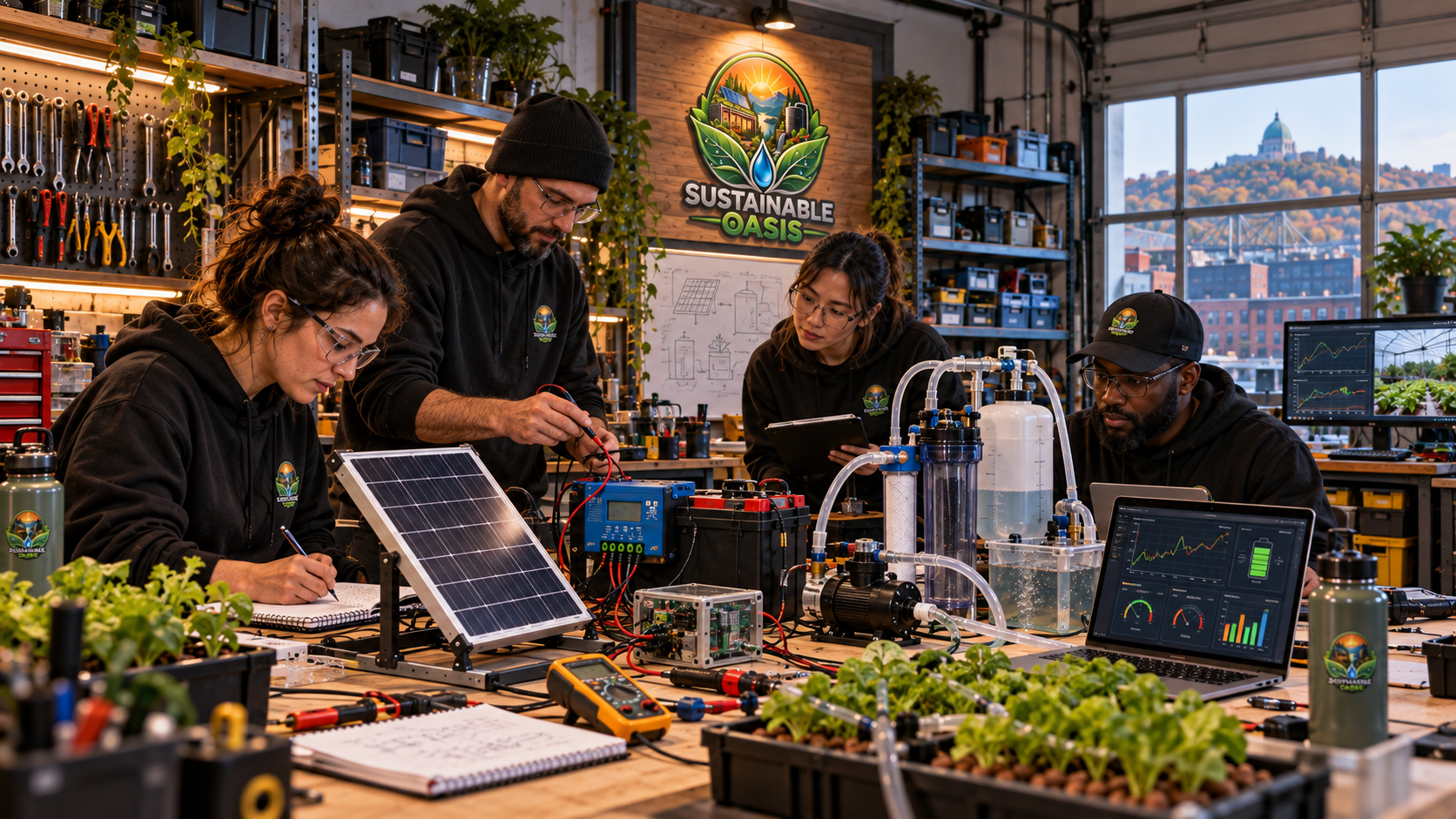
Garage Lab is the active Sustainable Oasis research and development environment in Montreal.
It gives us a practical place to prototype systems, install instrumentation, record data and learn before committing to larger infrastructure.
Energy, water, food, automation and integrated-system experiments can all begin here at manageable scale.
PROJECT STATUS
Garage Lab is intended to remain a working development environment rather than a finished showroom.
Systems can be assembled, changed, instrumented, compared and rebuilt as new evidence becomes available.
Not every experiment needs to succeed. Every useful experiment should teach us something.
GARAGE LAB ROLE
LAB DOMAINS
Low-voltage measurement, batteries, loads, recovery experiments and SO-EMS development.
Energy Lab →Tanks, pumps, gravity, head pressure, flow and water-recovery testing.
Water Lab →Growing systems, aquaponics, irrigation, productivity and resource-use experiments.
Food Lab →Sensors, local controls, relays, alarms, actuators and verification.
Automation Lab →Instrumented measurement of energy input, output, storage, recovery and losses.
SO-EMS →Test how energy, water, food and automation influence each other.
Complete Oasis →MEASUREMENT FIRST
Ideas can be exciting, but the purpose of the laboratory is to determine what the physical system actually does.
Useful measurements can include voltage, current, power, energy, water volume, flow, pressure, temperature, duration and system state.
Measurements should remain connected to units, timestamps, instrumentation and experiment boundaries.
GARAGE LAB — SO-EMS
The Sustainable Oasis Energy Management System is one of the central Garage Lab research programs.
SO-EMS begins with measurement: voltage, current, power and energy over time.
Once the measurement foundation is reliable, more complex storage, routing and recovery experiments can be evaluated with stronger evidence.
ENERGY ACCOUNTING
Garage Lab energy experiments should include all meaningful inputs, storage changes and auxiliary loads.
ENERGY IN = USEFUL OUTPUT + STORAGE CHANGE + LOSSES
Recovered energy can reduce waste and improve system efficiency.
It does not create new energy outside the accounting boundary.
ENERGY RESEARCH
Garage Lab provides a place to investigate energy concepts without assuming the result in advance.
Develop the measurement foundation for energy experiments.
M01 →Measure whether energy normally lost during operation can be recovered usefully elsewhere.
Experiment Registry →Investigate rotational storage with complete input, output and loss accounting.
Research →Compare compression input with useful recovered output.
Research →Evaluate the physical behavior while accounting for every external input, stored-energy change and loss.
Research →Compare several energy sources within one common measurement framework.
Experiment Registry →GARAGE LAB — WATER
Small tank-and-pipe experiments can help characterize head pressure, flow, pumping requirements and recovery concepts.
Static water pressure depends primarily on vertical head rather than the amount of water stored by itself.
Future bench experiments can compare predicted flow with measured behavior.
GARAGE LAB — FOOD
Garage Lab food experiments can compare growing methods using harvest, area, water, energy and time.
Aquaponic systems can also be studied as coupled biological and mechanical systems.
GARAGE LAB — AUTOMATION
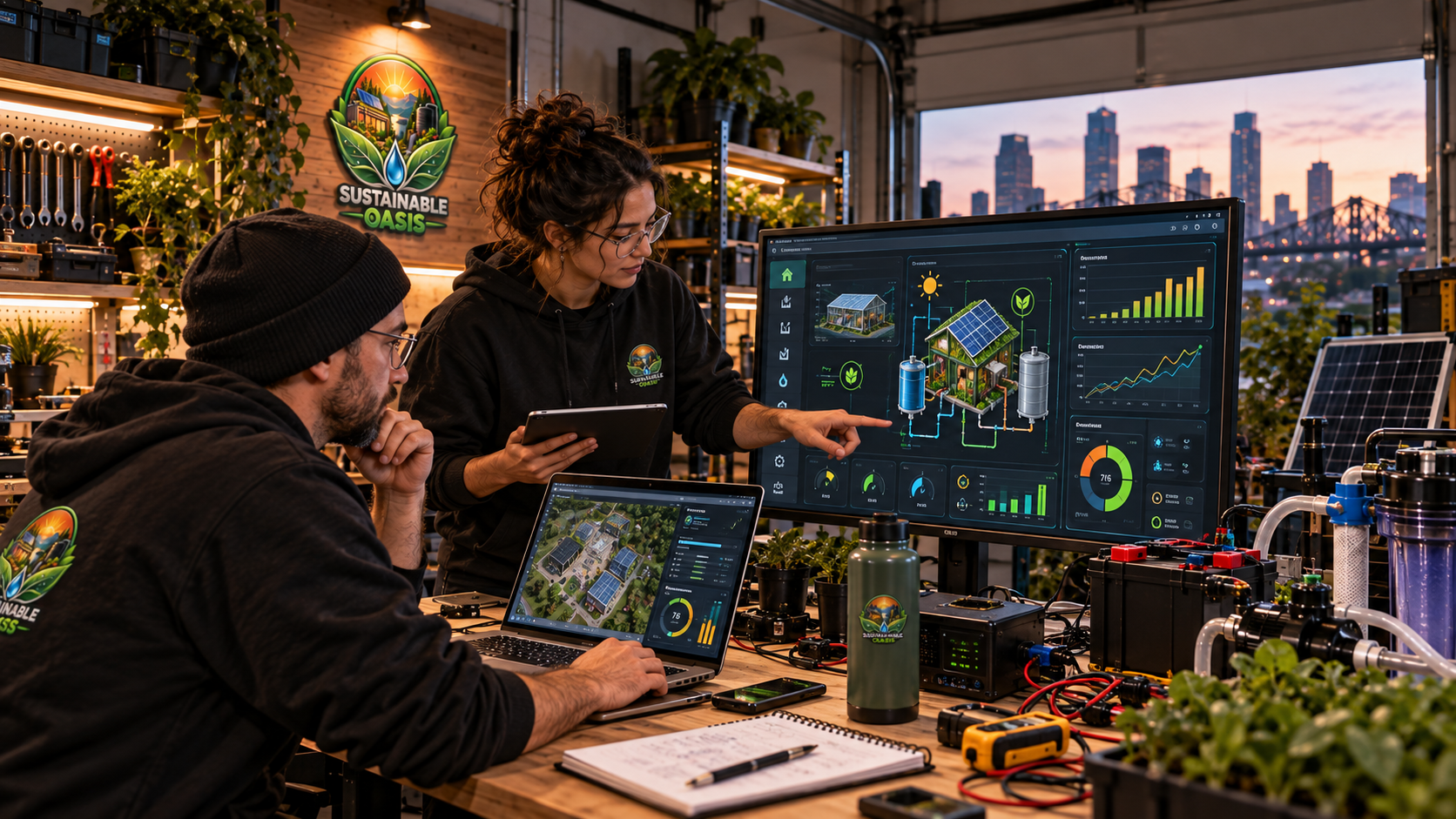
Garage Lab can test sensors, local controllers, relays, actuators, alarms and verification logic.
Automation should measure first, act second and verify the result afterward.
FAIL SAFE
A resilient system should not become unusable because a network connection, controller or sensor fails.
Where practical, critical pumps, valves, lighting and safety functions should retain understandable local control.
GARAGE LAB — CONTROL ROOM
The Sustainable Oasis Control Room provides the organizational layer for experimental and operational information.
Garage Lab data can eventually move from individual measurements into structured dashboards, datasets and reports.
DATA DISCIPLINE
Example values used for interfaces or educational explanation.
DEMOValues calculated from assumptions.
ESTIMATEDValues physically recorded from an experiment.
MEASUREDCalculations based on documented source measurements.
DERIVEDGARAGE LAB METHOD
State the question and system boundary.
Identify variables that need to remain comparable.
Use appropriate instruments and units.
Preserve raw observations before interpretation.
Compare results with the original question.
Replicate tests when stronger confidence is needed.
FAILURE IS DATA
Garage Lab should preserve useful negative results, design mistakes and inconclusive tests.
The objective is not to make every experiment look successful.
The objective is to increase the quality of the next decision.
WORKSHOP DESIGN
Dedicated areas for repeatable experiments.
Clearly separated, protected and labeled electrical work areas.
Pumps, tanks and flow experiments with controlled drainage.
Organized parts, tools and test equipment.
Record measurements, photos, notes and experiment results.
Keep higher-risk experiments appropriately controlled and separated.
LAB SAFETY
Batteries can deliver extremely high fault current.
Electrical experiments, rotating equipment, pressure systems, pumps, tools and thermal experiments all require appropriate controls.
Mains electrical work and other regulated work may require qualified professionals.
Garage Lab should favor controlled low-voltage experimentation whenever that can answer the research question safely.
GARAGE → FIELD
WHERE GARAGE LAB FEEDS NEXT
Move successful compact systems into a real modular infrastructure environment.
Container Workshop →Compare laboratory assumptions with terrain, climate and field conditions.
Vietnam Oasis →Apply compact-system lessons to future portable infrastructure.
Mobile Oasis →Combine mature modules into the larger integrated model.
Complete Oasis →GARAGE LAB — DOCUMENTATION
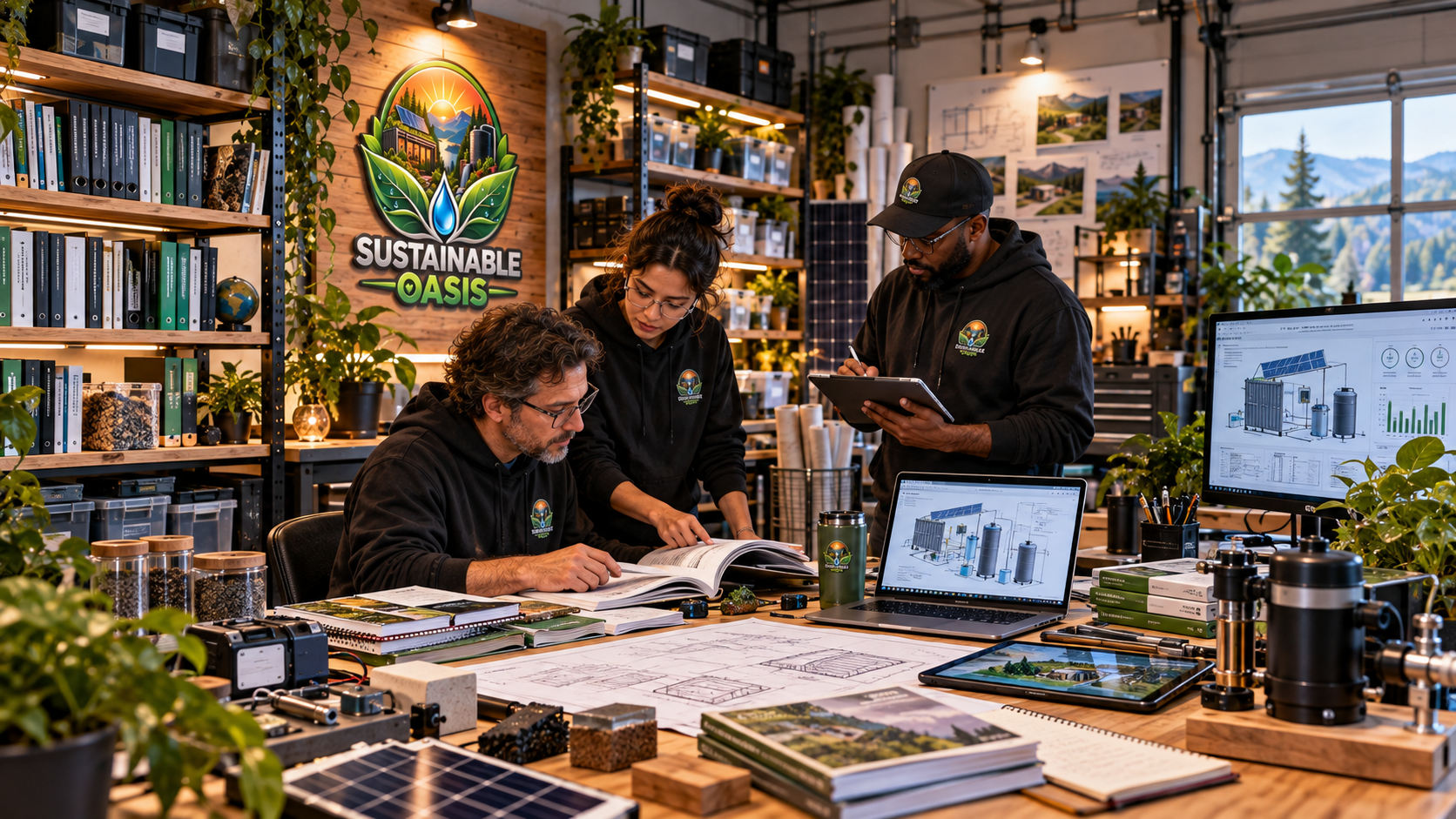
Every meaningful Garage Lab test can produce reusable documentation.
Raw data, field notes, photographs, diagrams, reports and conclusions can become part of the Sustainable Oasis Knowledge Base.
KNOWLEDGE PIPELINE
FUTURE GARAGE LAB RESOURCES
Structured experimental measurements.
FUTUREPractical lessons from successful experiments.
FUTUREReusable architecture from mature prototypes.
FUTUREMethods, results, limitations and conclusions.
FUTURERepeatable forms for future experiments.
FUTUREGARAGE LAB PRINCIPLES
Find problems before they become expensive.
Include meaningful inputs, outputs and storage changes.
Keep demo, estimated, measured and derived information distinct.
Negative results can protect future projects.
Larger infrastructure should follow evidence, not excitement alone.
OUR NORTH STAR
Every experiment should move us toward infrastructure that consumes less, protects more and can be understood by the next builder.
IN THE FUTURE, SUCCESS WILL NOT BE MEASURED BY WHAT WE HAVE, BUT BY WHAT WE PROTECT.
SUSTAINABLE OASIS PROJECTS
Small-scale experimentation, measurement and prototyping.
Garage Lab →Compact modular infrastructure under development.
Container Workshop →Terrain, water, growing systems and field learning.
Vietnam Oasis →Future mobile integrated infrastructure.
Mobile Oasis →Combine validated systems into one measurable whole.
Complete Oasis →GARAGE LAB