Tracked Propulsion
Explore low-speed electric propulsion, traction, steering, terrain interaction and mechanical efficiency.
PROJECT — MOBILE OASIS
Mobile Oasis is a future Sustainable Oasis research platform exploring how energy, water, shelter, automation and measurement systems could operate inside a deployable mobile unit.
The long-term concept is a large modular platform capable of moving across suitable terrain, deploying selected infrastructure and operating as a temporary or semi-permanent Oasis.
Mobility adds difficult constraints. That is exactly what makes the project valuable as an engineering challenge.
PROJECT STATUS
Mobile Oasis is currently a future research and development concept.
No production-ready autonomous mobile unit is being claimed.
The project should progress through engineering analysis, subsystem prototypes, mobility tests and controlled field trials before any larger implementation is considered.
MOBILE ARCHITECTURE
A useful Mobile Oasis must integrate movement with the infrastructure required after it stops.
CORE DEVELOPMENT DOMAINS
Explore low-speed electric propulsion, traction, steering, terrain interaction and mechanical efficiency.
Future architecture can investigate multiple independent track assemblies to improve terrain adaptation and load distribution.
Storage, propulsion, stationary loads, renewable generation and recovery all require one complete energy balance.
Energy Systems →Compact storage, pumping, treatment and deployable distribution.
Water Systems →Compact shelter, working space, storage and environmental control.
Shelter Systems →Sensors, motion control, state monitoring, alarms, safe states and manual override.
Automation Systems →FUTURE PLATFORM
One long-term Mobile Oasis concept explores a platform based around the approximate footprint of a 40-foot container.
The container-like form provides a familiar modular envelope for equipment, storage, utilities and future deployable systems.
The mobility system would remain a separate engineering layer beneath the infrastructure module, allowing both areas to evolve independently.
FOUR-TRACK CONCEPT
A future version can investigate four independent tracked modules, each contributing support, traction and terrain adaptation.
Independent traction, suspension and load support.
Independent traction, suspension and load support.
Independent traction, suspension and load support.
Independent traction, suspension and load support.
MOBILITY RESEARCH
Propulsion requirements depend on vehicle mass, terrain, speed, grade, rolling resistance, drivetrain efficiency and operating conditions.
Mobile Oasis should therefore begin with low-speed engineering models and subsystem tests before full-scale mobility is attempted.
Energy-per-distance will be one of the central performance metrics.
MOBILE ENERGY SYSTEM
Mobile Oasis creates two major energy modes: movement and stationary operation.
Propulsion motors, electronics, pumps, ventilation, lighting, communications and other loads all consume from the available energy system.
The accounting boundary must include charging losses, conversion losses, auxiliary loads and storage changes.
ENERGY IN = USEFUL OUTPUT + STORAGE CHANGE + LOSSES
ENERGY RECOVERY
Regenerative braking and other recovery methods may reduce total system losses.
Recovered energy comes from energy already present in the system, such as vehicle kinetic energy.
It should therefore be measured as recovery rather than treated as a new independent energy source.
RENEWABLE SUPPORT
Solar generation is more useful when the Mobile Oasis is stationary than while propulsion demand is high.
The project can explore fixed or deployable solar surfaces for charging, auxiliary loads and stationary operation.
Array sizing should be based on realistic solar conditions, usable surface area and measured demand.
Solar CalculatorMOBILE WATER SYSTEM
Water is necessary, but carrying large volumes also adds substantial vehicle mass.
Mobile Oasis should therefore balance onboard storage with local collection, treatment and resupply.
Rainwater capture, filtration and controlled reuse may reduce how much water must be transported.
DEPLOYMENT MODE
DEPLOYABLE INFRASTRUCTURE
Deployable generation, storage and distribution.
Storage, treatment and distribution.
Protected living, work and equipment space.
Local networking, data recording and remote communication.
Instrumentation and research capability.
Tools and repair capacity for field maintenance.
MOBILE AUTOMATION
Future Mobile Oasis automation can include propulsion control, track monitoring, energy management, system alarms, positioning and infrastructure deployment.
Automated operation should retain clear safe states and appropriate manual control.
Essential systems should not rely exclusively on remote cloud connectivity.
MANUAL CONTROL
Mobile Oasis should retain practical local controls for critical functions.
Emergency stop, system isolation, propulsion disable and manual infrastructure control should remain part of the architecture.
MOBILE CONTROL ROOM
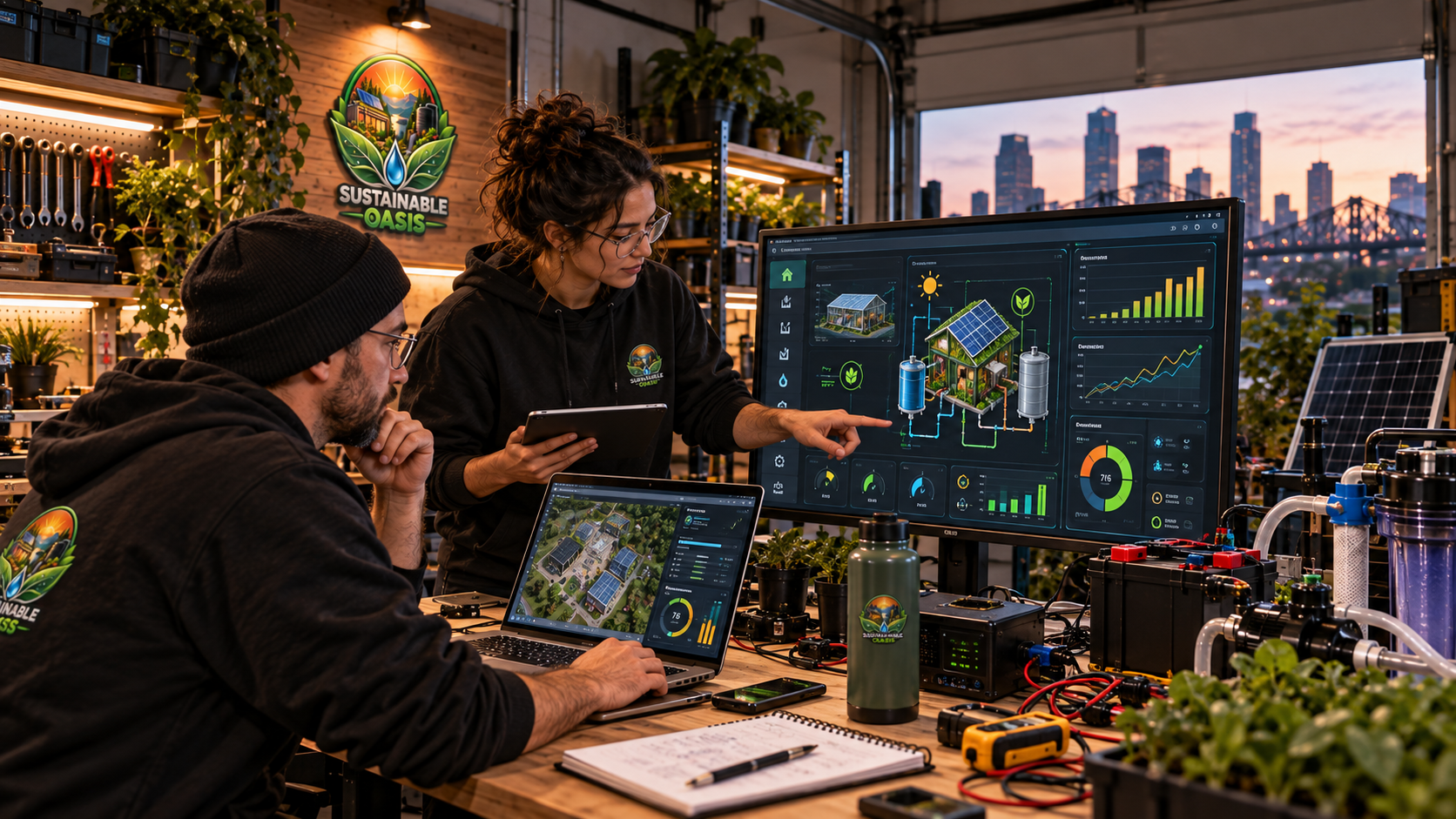
A Mobile Oasis Control Room could combine mobility, energy, water, infrastructure and environmental information.
The purpose is not to create an impressive dashboard.
The purpose is to understand the state of the platform well enough to operate, troubleshoot and improve it.
DATA DISCIPLINE
Example values for interface development.
DEMOModeled values based on documented assumptions.
ESTIMATEDValues recorded from real platform tests.
MEASUREDCalculations produced from documented source measurements.
DERIVEDTERRAIN
Terrain capability should be defined using real engineering limits rather than broad claims.
Define safe operating grades through testing and stability analysis.
Vehicle mass and track area influence ground pressure.
Obstacles and terrain geometry constrain mobility.
Center of gravity and load distribution must remain inside safe limits.
FIELD MODE
Mobile Oasis is most valuable if mobility enables infrastructure rather than becoming the entire project.
Once positioned, the platform can potentially support energy, water, shelter, communications, workshop and research functions.
DEVELOPMENT PATH
PROTOTYPE STRATEGY
Motor, reduction, track, brake, suspension and load testing.
Low-speed torque control, current limits, thermal behavior and emergency shutdown.
Capacity, discharge, charge rate, thermal limits and protection.
Coordinated track control and low-speed directional testing.
Load distribution, articulation and terrain adaptation.
Sensors, local control, communications, safe states and diagnostics.
SAFETY
Mobile machinery introduces significant mechanical, electrical and kinetic hazards.
Future development should include emergency stop systems, braking, isolation, fault detection, safe operating zones and controlled test procedures.
Battery systems also carry high fault-current and thermal risks, even at comparatively low system voltage.
Engineering, fabrication, transport and operation may also be subject to applicable regulations and professional review.
MOBILE OASIS — RESEARCH
The Mobile Oasis program can create research questions involving traction, energy use, storage, terrain, automation and deployment.
Bench tests and smaller prototypes can isolate individual variables before larger field tests are attempted.
RESEARCH QUESTIONS
How much energy is required per unit distance under defined conditions?
Which grades and surfaces can be traversed safely?
How does equipment placement affect traction and stability?
How long can essential Oasis loads operate from available resources?
How quickly can the platform transition from travel to operating mode?
GARAGE LAB → MOBILE OASIS
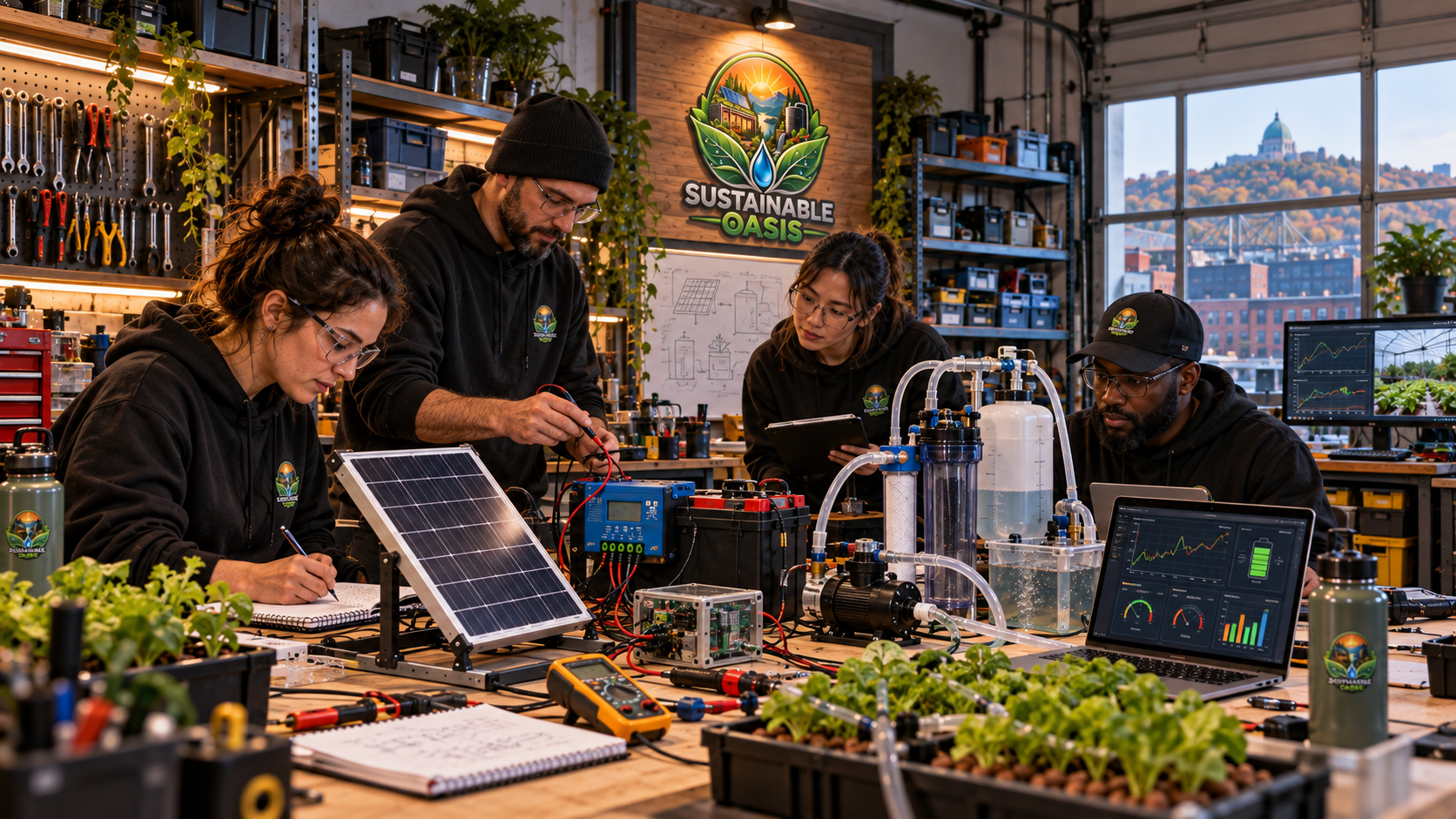
Garage Lab can support early Mobile Oasis experiments involving measurement, motor controls, battery systems, sensors and automation.
Small prototypes make it possible to explore system behavior without beginning with the cost and complexity of a full-size vehicle.
Garage LabCONTAINER WORKSHOP → MOBILE OASIS
The Container Workshop can teach lessons about fitting energy, water, storage, controls and service access inside a constrained envelope.
Those lessons can later influence Mobile Oasis design.
Container WorkshopMOBILE OASIS → COMPLETE OASIS
Many Mobile Oasis systems can share the same fundamental architecture as stationary Oasis sites.
Energy management, water, automation, measurement and serviceability can all contribute lessons to the Complete Oasis model.
Mobility simply introduces another demanding layer of constraints.
MOBILE OASIS — KNOWLEDGE
Mobility models, energy calculations, motor tests, suspension experiments, control architectures and field observations can all become useful knowledge.
Future documentation can preserve what worked, what failed and which assumptions changed.
KNOWLEDGE PIPELINE
CAPITAL DISCIPLINE
A full-scale tracked Mobile Oasis could require substantial capital for motors, controls, batteries, steel, tracks, suspension, fabrication and testing.
Sustainable Oasis can reduce risk by proving expensive subsystems independently before financing the entire platform.
Large-scale construction should follow economic progress rather than become the first major burden on the project.
FUTURE MOBILE OASIS RESOURCES
Define mission, mass, terrain, autonomy and operating limits.
FUTUREFuture mechanical and infrastructure architecture.
FUTUREMotors, tracks, batteries, controls, structural components and utilities.
FUTUREMobility, energy, terrain and system performance data.
FUTUREOperating procedures, emergency controls and test boundaries.
FUTUREResults, failures, limitations and design changes.
FUTUREMOBILE OASIS PRINCIPLES
Every kilogram affects propulsion and terrain capability.
Separate mobility from infrastructure where practical.
Understand the real energy cost of movement.
Preserve safe states, isolation and manual recovery.
Let evidence justify the full-scale platform.
OUR NORTH STAR
Mobile Oasis is ultimately about bringing useful, resilient systems into environments where permanent infrastructure may not yet exist.
IN THE FUTURE, SUCCESS WILL NOT BE MEASURED BY WHAT WE HAVE, BUT BY WHAT WE PROTECT.
SUSTAINABLE OASIS PROJECTS
Develop measurement, controls and subsystem prototypes.
Garage Lab →Learn compact modular infrastructure integration.
Container Workshop →Learn from terrain, water and field conditions.
Vietnam Oasis →Explore deployable resilient infrastructure.
Mobile Oasis →Connect mature systems into one larger architecture.
Complete Oasis →MOBILE OASIS