Energy
Generation, storage, consumption and recovery.
Energy Control →CONTROL ROOM — REVENUE
Sustainable Oasis needs more than good ideas. Research, infrastructure, prototypes, documentation and replication all require resources.
The Revenue Control Room provides a clear place to organize revenue streams, actual income, costs, recurring revenue and reinvestment.
The rule is simple: expected revenue is not revenue received.
CONTROL ROOM DOMAINS
Generation, storage, consumption and recovery.
Energy Control →Collection, storage, treatment and reuse.
Water Control →Production, growing area and resource efficiency.
Food Control →Equipment, shelter, maintenance and readiness.
Infrastructure Control →Efficiency, conservation, resilience and measurable change.
Impact Control →Income, costs, recurring revenue and reinvestment.
Revenue Control →THE ECONOMIC LOOP
REVENUE DASHBOARD
The values below are placeholders illustrating the future reporting structure.
No financial performance is claimed here. Actual revenue should be entered only when a transaction has genuinely occurred and its source can be identified.
REVENUE DATA DISCIPLINE
Example financial information used to explain the interface.
DEMOExpected revenue based on assumptions, pricing or sales targets.
ESTIMATEDRevenue actually received from a documented transaction.
ACTUALMargins, averages and other values calculated from recorded financial data.
DERIVEDCORE ECONOMIC RULE
A product priced at a certain amount does not create revenue until someone actually buys it.
A planned contract is not received revenue.
A traffic estimate is not a customer.
The Revenue Control Room should preserve this distinction at every stage.
REVENUE STREAMS
Sustainable Oasis can develop several complementary revenue channels without requiring every project to depend on the same source.
Products, infrastructure, kits and resilient-system components.
Visit Store →Guides, plans, calculators, templates, books and reusable knowledge products.
Downloads →Future system planning, design support and technical services based on validated experience.
Services →Practical learning paths developed from Sustainable Oasis systems and research.
Academy →Publishing can transform ideas, experience and the Sustainable Oasis journey into long-lived intellectual property.
Books →Voluntary support can help fund documentation, experiments and public resources.
Sustainable Oasis Life →REVENUE PORTFOLIO
Revenue diversification can reduce dependence on any single product, platform or customer group.
RECURRING REVENUE
One-time sales are useful, but recurring income can make planning and reinvestment more predictable.
Recurring revenue should only be counted while the customer relationship remains active and payment is genuinely being received.
GROSS ≠ NET
A sale can generate revenue while also creating product, transaction, shipping, advertising, labor or service costs.
A simple operational relationship is:
NET CONTRIBUTION = REVENUE RECEIVED − DIRECT COSTS
Additional overhead and tax obligations may also need to be considered separately.
COST CONTROL
Sustainable Oasis should understand where operating money is going, just as the Energy Control Room follows energy.
Hosting, software, insurance and other recurring costs.
Materials, packaging, purchasing and fulfillment.
Advertising, marketplace fees and transaction costs.
Prototypes, testing, equipment and infrastructure.
Transportation, maintenance, communications and administration.
Time is a real resource even when no external invoice is issued.
UNIT ECONOMICS
Revenue can increase while a business becomes weaker if every sale loses money.
Unit economics help evaluate whether an individual product or service contributes enough to support continued operation.
CONTRIBUTION MARGIN = SALE PRICE − DIRECT COST
DIGITAL ECONOMY
Guides, calculators, plans, templates and books can transform documented experience into reusable products.
Digital products still require development, support, platform fees and marketing, but they do not require physical inventory for each individual copy.
KNOWLEDGE → VALUE
PHYSICAL PRODUCTS
Sustainable Oasis Store can connect physical products, infrastructure, kits and services with the broader ecosystem.
Product-level economics should track revenue received alongside purchasing, fulfillment and transaction costs.
SERVICES
Sustainable Oasis can develop future services around planning, design, consultation, installation support and infrastructure.
Preliminary resource and infrastructure planning.
Structured resilient-system architecture and integration.
Practical guidance based on documented experience.
Future physical-system development and support.
PUBLISHING + EDUCATION
Sustainable Oasis books and Academy material can turn years of thinking, experimentation and documentation into long-lived assets.
The economic value comes after useful information has actually been created.
PROJECT ECONOMICS
Track prototype spending, research costs and economic outputs.
Garage Lab →Track infrastructure development, materials and future productive uses.
Container Workshop →Track future field investment, production and resource-system economics.
Vietnam Oasis →Compare capital requirements, operating costs and productive output.
Complete Oasis →These fields intentionally contain no invented financial values. Revenue should appear only after real transactions are recorded.
TRANSACTION DISCIPLINE
When was the transaction received?
Which product, service or channel created it?
How much did the customer actually pay?
What direct expense was required for the sale?
What remained before broader overhead and other obligations?
REVENUE FUNNEL
CONVERSION
Website visits alone do not create economic sustainability.
The Revenue Control Room can eventually connect traffic, inquiries, purchases and recurring customers while respecting privacy.
A basic conversion relationship is:
CONVERSION RATE = CUSTOMERS ÷ QUALIFIED VISITORS × 100
CASH FLOW
Cash flow tracks when money actually enters and leaves the operation.
Revenue, expenses and timing should therefore be examined together.
NET CASH FLOW = CASH IN − CASH OUT
FINANCIAL RESILIENCE
Runway is a practical indicator of how long current financial resources can support ongoing costs.
A simplified planning relationship is:
RUNWAY = AVAILABLE CASH ÷ MONTHLY NET CASH USE
It should be calculated from current financial data, not optimistic future sales.
REINVESTMENT
Economic success can support the next stage of Sustainable Oasis instead of becoming disconnected from the mission.
Protect essential operating requirements first.
Fund systems that reduce waste or increase productive capability.
Support experiments that can create reusable knowledge.
Preserve what was learned so the value is not lost.
Scale only what has become strong enough to reproduce.
IMPACT + REVENUE
Sustainable Oasis should be able to examine both financial performance and resource impact.
A profitable activity may fund meaningful work.
A meaningful activity that cannot sustain itself may require another economic engine to support it.
THE SUSTAINABLE OASIS FLYWHEEL
CAPITAL PRIORITIZATION
Revenue creates choices. The Control Room should help make those choices visible.
Expenses required to keep core operations functioning.
Investments capable of supporting future economic activity.
Experiments capable of creating meaningful evidence or intellectual property.
Investments that help reproduce already validated systems.
CAPITAL DISCIPLINE
Sustainable Oasis can use smaller prototypes, digital products, services and knowledge assets to build economic capacity before larger permanent investments are undertaken.
This keeps the next major physical step connected to demonstrated economic progress rather than hope alone.
COMPOUNDING VALUE
REVENUE + RESEARCH
Research may not produce immediate revenue.
A diversified economic engine can support the time, equipment and documentation required to test ideas properly.
The resulting knowledge can later create products, education, intellectual property or improved physical systems.
ECONOMIC REPORTING
Record actual income by source.
Record the resources required to create that income.
Understand what remained after relevant direct costs.
Record where economic capacity was redeployed.
Preserve which revenue experiments worked and which did not.
REVENUE + KNOWLEDGE
A product that does not sell, a channel that is too expensive, or an offer that converts poorly can still produce useful information.
Sustainable Oasis can document economic experiments with the same discipline used for technical experiments: hypothesis, test, result and improvement.
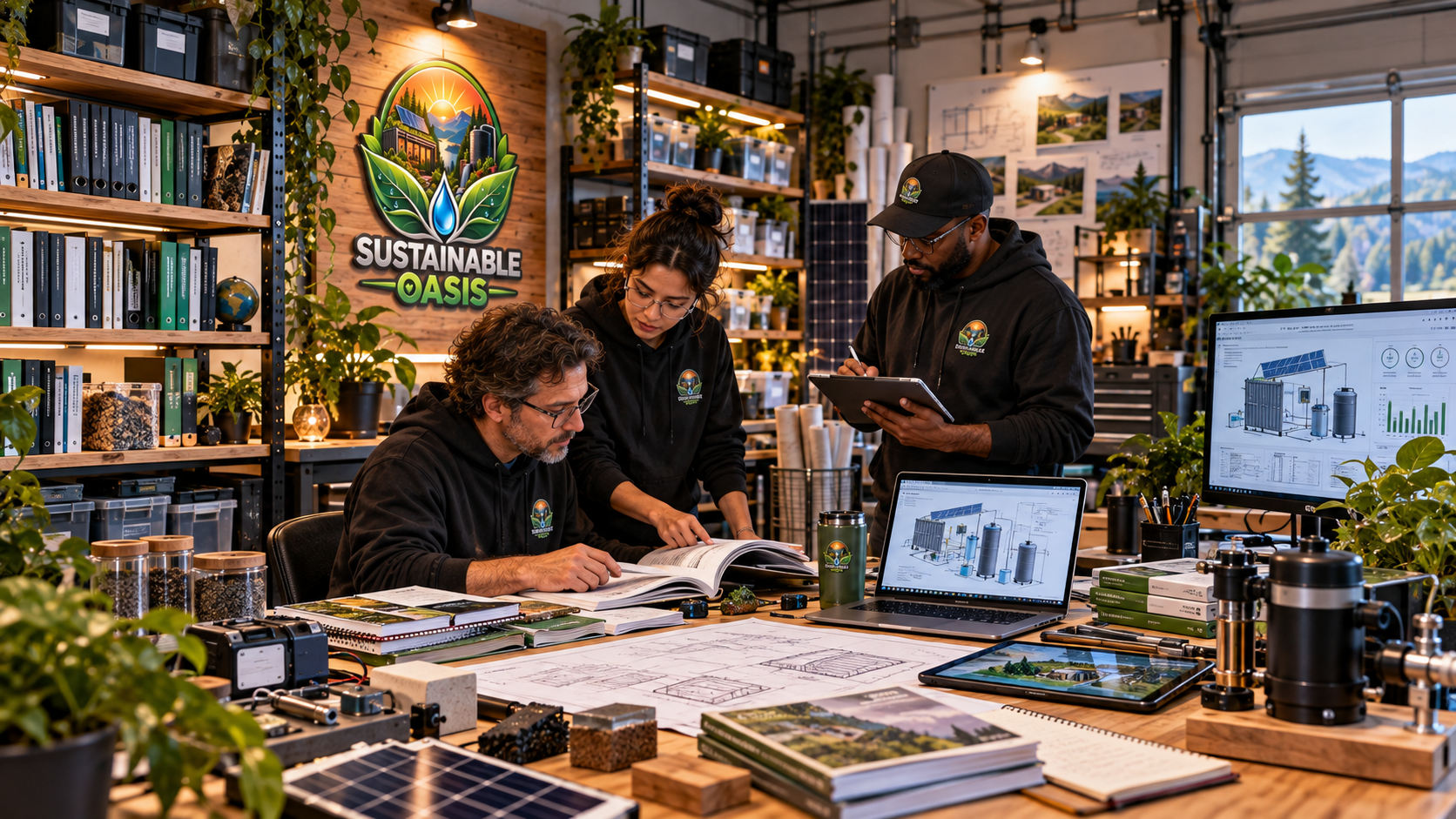
COMPLETE OASIS ECONOMICS
The long-term Control Room can connect physical resources with economic performance in one integrated model.
REVENUE PRINCIPLES
Never present projected revenue as money received.
Revenue without costs can create a misleading picture.
Build several compatible revenue channels over time.
Use economic progress to strengthen the infrastructure beneath the mission.
Let each project create lessons that make the next project stronger.
ECONOMIC INTELLIGENCE PIPELINE
ECONOMIC NORTH STAR
Sustainable Oasis can use economic success to protect time, fund experimentation, build infrastructure and preserve knowledge.
IN THE FUTURE, SUCCESS WILL NOT BE MEASURED BY WHAT WE HAVE, BUT BY WHAT WE PROTECT.
COMPLETE CONTROL ROOM
REVENUE CONTROL ROOM