
Energy
Generation, storage, consumption and recovery.
Energy Control →CONTROL ROOM — IMPACT
The Impact Control Room brings together resource efficiency, recovery, waste reduction, resilience and system-performance indicators.
Its purpose is not to create impressive claims. Its purpose is to help Sustainable Oasis understand what changed, why it changed and whether the result can be supported by evidence.
Impact begins with measurable system boundaries and transparent data classifications.
CONTROL ROOM DOMAINS
Generation, storage, consumption and recovery.
Energy Control →Collection, storage, treatment, use and reuse.
Water Control →Production, resource use and productivity.
Food Control →Physical systems, condition and maintainability.
Infrastructure Control →Efficiency, recovery, conservation and resilience.
Impact Control →Future connection between impact and economic sustainability.
Revenue Control →IMPACT MODEL
Sustainable Oasis impact should be connected to observable differences in resource use, recovery, resilience or productivity.
IMPACT DASHBOARD
The dashboard below illustrates the structure of future impact reporting.
Demonstration structure only. Impact indicators should not be presented as measured until physical data exists.
EVIDENCE LEVEL
Example information used to explain reporting structure.
DEMOExpected impact calculated from assumptions or models.
ESTIMATEDImpact supported by documented physical measurements.
MEASUREDImpact calculated from documented source measurements.
DERIVEDENERGY IMPACT
Energy impact can include reduced demand, renewable generation, improved efficiency and useful recovery.
Recovery must remain inside the same energy balance and should never be counted as newly created energy.
WATER IMPACT
Water impact can include capture, conservation, reuse and improved autonomy.
The objective is not merely to store more water. It is to reduce unnecessary demand and use available water intelligently.
WATER RECOVERY
Recovered water remains part of the same overall water system.
A litre reused internally should not also be counted as a new litre entering the system.
Impact reporting should distinguish between water captured, water consumed, water recovered and freshwater demand avoided.
FOOD IMPACT
Food-system impact can include useful production, water efficiency, growing-area productivity and reduced dependence on external supply.
Harvest alone does not describe the full system.
INFRASTRUCTURE IMPACT
Impact is influenced by how infrastructure performs over time — not simply how it looks when first installed.
Longer-lived infrastructure can reduce replacement frequency.
Maintainable components can extend system usefulness.
Replace only the component that actually needs replacement.
Better system design can reduce ongoing energy and water demand.
RESILIENCE IMPACT
A system may create meaningful value by reducing dependence on a single source or by extending the time essential needs can be supported.
Resilience indicators remain planning tools until real system performance is tested.
WASTE REDUCTION
Sustainable Oasis looks for opportunities to reduce, recover, reuse or redesign resource flows before disposal.
DEFINE THE BOUNDARY
An apparent improvement can disappear when hidden energy, materials, pumps, transport, replacement parts or other inputs are included.
Sustainable Oasis impact reporting should state the system boundary clearly enough for the result to be understood and challenged.
BASELINES
Before claiming a reduction or improvement, Sustainable Oasis should define the original operating condition.
Record the original system condition.
Gather baseline data where practical.
Implement the improvement being tested.
Record performance under comparable conditions.
Calculate the difference without hiding uncertainty.
CHANGE
For many resource indicators:
CHANGE = BASELINE − CURRENT PERFORMANCE
Whether a positive or negative difference represents improvement depends on the metric being studied.
The result should always retain its units, time period and system boundary.
IMPACT + RESEARCH
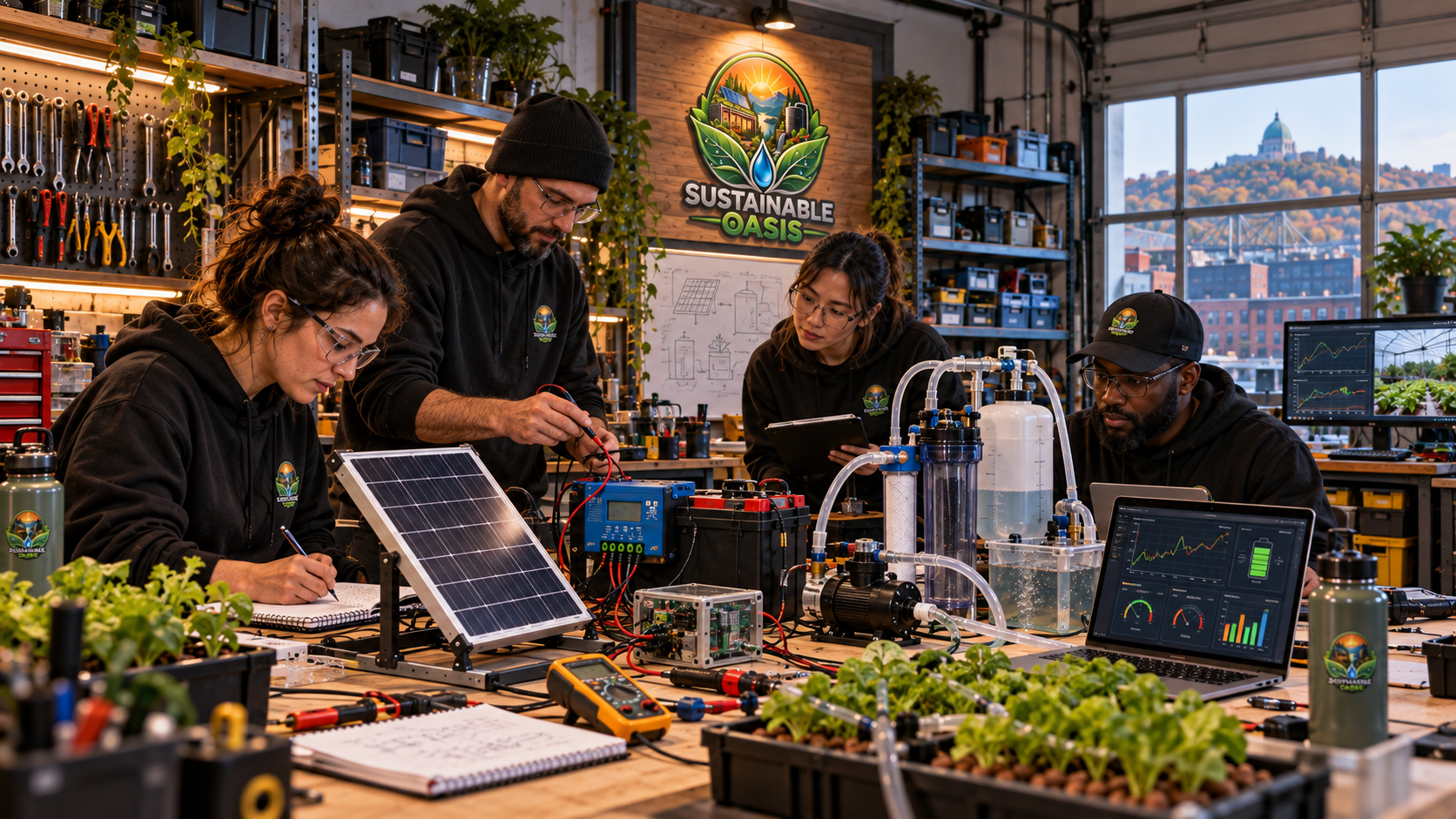
Sustainable Oasis research should preserve the question, system boundary, instrumentation, procedure, raw data and conclusion.
Unsupported, inconclusive and failed experiments remain valuable because they help prevent misleading conclusions.
IMPACT REPORTING
Sustainable Oasis reports should preserve uncertainty and unfavorable results rather than selecting only positive outcomes.
Define the question and system boundary.
Identify source data and measurement conditions.
Present the result without exaggeration.
Preserve limitations and uncertainty.
IMPACT BY PROJECT
Prototype performance, instrumentation and resource testing.
Garage Lab →Compact infrastructure, repairability and modular systems.
Container Workshop →Water, terrain, food and renewable-resource field observations.
Vietnam Oasis →Future integration of validated resource systems into one measurable environment.
Complete Oasis →COMPLETE OASIS IMPACT
Improvements in one domain can create benefits — or new costs — in another.
IMPACT PRINCIPLES
Know what existed before claiming improvement.
Avoid hiding important resource costs.
Recovered resources remain part of the original system flow.
Do not turn incomplete evidence into certainty.
Negative and inconclusive results can protect future resources.
IMPACT + KNOWLEDGE
Impact data can become reports, case studies, guides and future blueprints.
The purpose of documentation is to make successful improvements easier to repeat and failed ideas less expensive to rediscover.

IMPACT INTELLIGENCE PIPELINE
OUR NORTH STAR
Sustainable Oasis exists to understand whether our systems genuinely protect resources, strengthen resilience and create knowledge that can help others build better.
IN THE FUTURE, SUCCESS WILL NOT BE MEASURED BY WHAT WE HAVE, BUT BY WHAT WE PROTECT.
NEXT CONTROL ROOM
The Revenue Control Room connects Sustainable Oasis projects and activities with the economic layer needed to continue funding research, infrastructure and replication.
IMPACT CONTROL ROOM