Approximately 43,000 ft²
A substantial field site for water, food, living and renewable systems.
PROJECT — VIETNAM OASIS
Vietnam Oasis is a Sustainable Oasis field site in the Bao Lam and Bao Loc region where terrain, water, food production and renewable energy can be developed as one connected system.
Unlike a controlled laboratory, the site introduces real elevation, rainfall, soil, growing conditions, distance, maintenance and infrastructure constraints.
Those constraints make the site valuable. They force Sustainable Oasis concepts to meet physical reality.
PROJECT STATUS
Vietnam Oasis is treated as a Sustainable Oasis field site.
Existing site work and observations provide practical context, while many future systems remain developmental and should not be presented as completed or fully validated.
The goal is to document what physically exists, what is planned, what is measured and what still needs testing.
SITE CHARACTERISTICS
Reported site characteristics provide the initial planning context for Vietnam Oasis.
A substantial field site for water, food, living and renewable systems.
The site is reported at more than 1,000 feet of elevation.
A deep-well project established a continuous water source for the site.
Elevation differences create opportunities for gravity-assisted distribution.
TERRAIN ARCHITECTURE
The upper area can support water storage and fish-production concepts while taking advantage of elevation above lower zones.
Any future gravity system should be sized from measured elevation difference, pipe losses and required flow.
The middle terrace can receive water from above and support productive growing systems.
Water demand, crop productivity and soil conditions can become measurable variables.
The lower area is intended for living and service functions such as kitchen, sanitation and basic utilities.
Placing demand below stored water may allow portions of the system to benefit from gravity distribution.
WATER SOURCE
The Vietnam Oasis well project targeted a deep groundwater source.
Site observations reported a continuous approximately one-inch water flow after the drilling work.
Future Sustainable Oasis documentation should convert those observations into measured flow rate, pumping depth, electrical demand and water-quality records.
PUMP UP — GRAVITY DOWN
One useful Vietnam Oasis architecture is to pump water to elevated storage and distribute it downward through gravity whenever practical.
This does not eliminate the energy required to raise the water.
It shifts part of the distribution system from continuous pumping toward stored gravitational potential.
MODULAR WATER STORAGE
Multiple 1,000-litre tank concepts allow water storage to expand incrementally.
Separate storage can support irrigation, operational reserve, experiments or evaporation compensation without requiring one enormous vessel.
Actual tank configuration should follow measured demand, structural support, overflow planning and water-quality requirements.
Water CalculatorGRAVITY DISTRIBUTION
When water is stored above its point of use, gravity can create pressure without continuous pump operation.
Static pressure depends primarily on vertical elevation difference.
Real flow also depends on pipe diameter, pipe length, fittings, valves and friction losses.
MICRO-HYDRO RESEARCH
Vietnam Oasis can provide a field environment for controlled micro-hydro experiments using available head and flow.
Any electrical output must be compared against the gravitational energy available in the moving water and any pumping energy required elsewhere in the system.
A turbine can recover part of existing hydraulic energy. It does not create additional energy outside the system boundary.
WATER PATH
FOOD PRODUCTION
The garden zone can connect water availability, soil conditions, crop selection and productive growing area.
Instead of measuring success only by harvest, Sustainable Oasis can also track water use, energy use, growing duration and area.
This turns food production into a system that can be improved over time.
FISH + GROWING SYSTEMS
Pond and aquaponic concepts may allow selected water infrastructure to support biological productivity alongside storage or circulation.
Explore appropriate fish-production systems for local conditions.
Monitor conditions required by plants and aquatic life.
Compare gravity-assisted and pumped circulation where appropriate.
Track harvest, area and resource intensity.
RENEWABLE ENERGY
Solar and wind concepts can support pumps, lighting, communications and other essential loads.
The first step is not simply installing more generation.
The first step is understanding actual demand, operating schedules and storage requirements.
SOLAR WATER LIFT
A dedicated solar-powered pump can potentially move water to elevated storage when solar energy is available.
The stored water can then provide time-shifted availability through gravity distribution.
Performance should be evaluated using water lifted, vertical head, electrical energy consumed and overall system efficiency.
SITE ELECTRICAL INFRASTRUCTURE
Field electrical infrastructure must account for long cable runs, protection, voltage drop, weather exposure and service access.
Temporary or neighboring electrical access can support development while independent systems mature.
Long cable distances make conductor sizing and voltage drop important.
Proper disconnects, overcurrent protection and qualified installation matter.
Solar and wind can gradually reduce dependence on external supply.
FIELD AUTOMATION
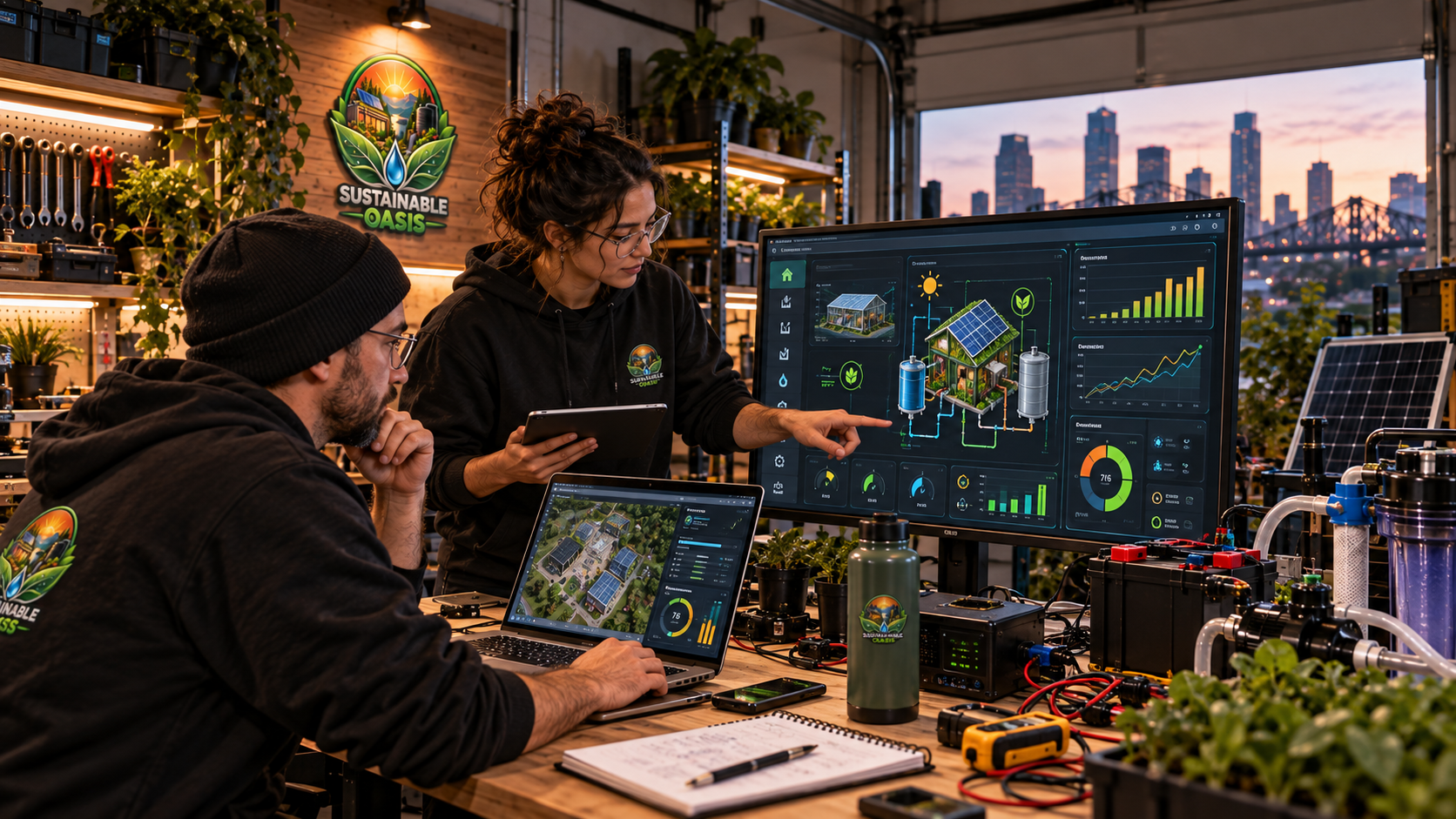
Vietnam Oasis can eventually use tank-level sensors, pump controls, smart valves and basic environmental monitoring.
Automation should begin with reliable measurement.
Essential water functions should retain practical manual control and safe-state behavior.
SMART WATER LOOP
VIETNAM OASIS — CONTROL ROOM
The Sustainable Oasis Control Room can eventually organize selected Vietnam Oasis energy, water, food and infrastructure information.
Remote monitoring can be useful, but essential functions should continue to operate locally where practical.
Cloud connectivity should add visibility, not become the only way to operate a critical system.
FIELD DATA DISCIPLINE
Example values used for interfaces or education.
DEMOPlanning values based on assumptions or models.
ESTIMATEDValues collected using documented field measurements.
MEASUREDCalculations based on documented source information.
DERIVED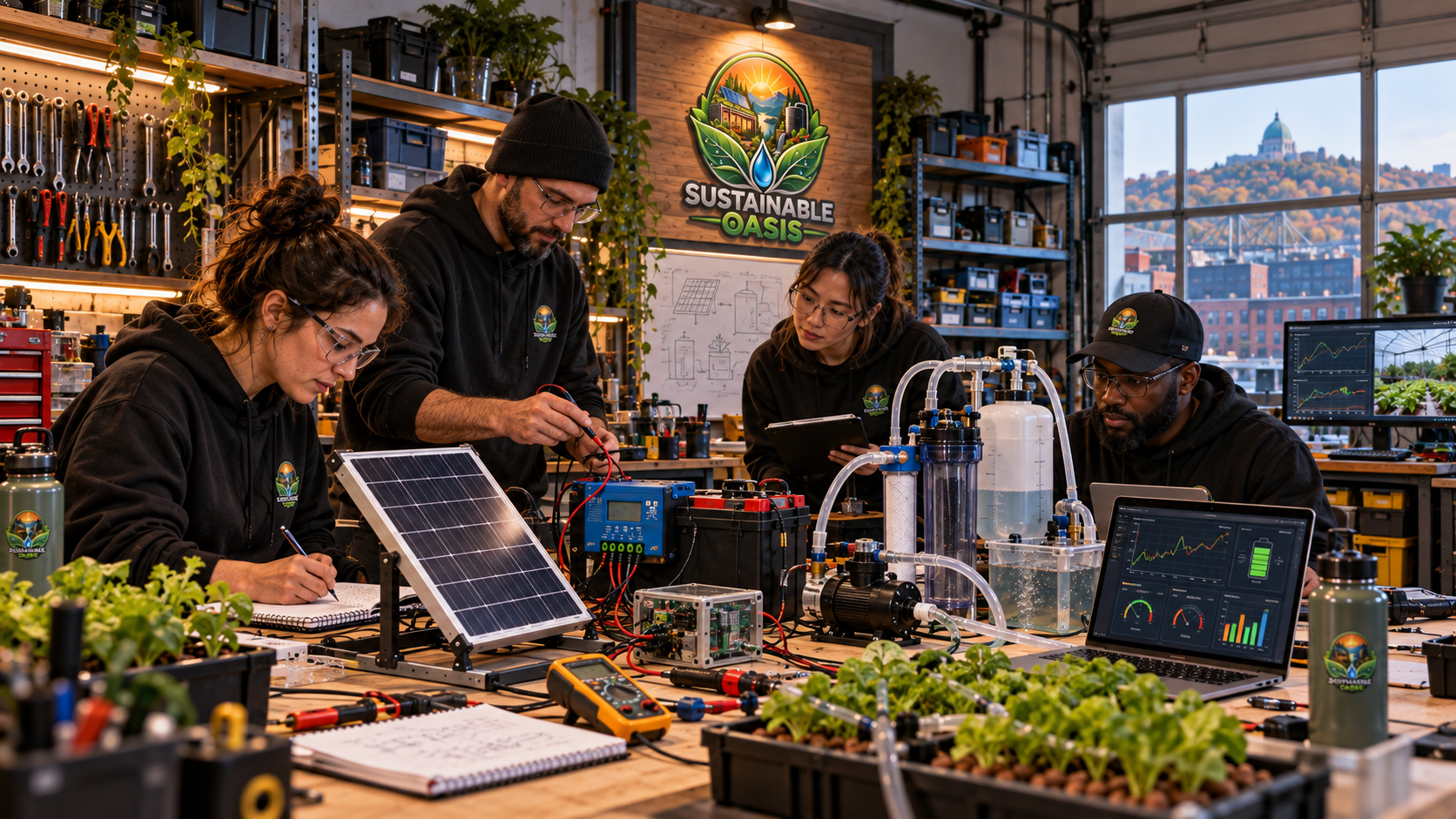
VIETNAM OASIS — FIELD RESEARCH
Vietnam Oasis can test Sustainable Oasis systems against real weather, terrain, biological conditions and maintenance realities.
Field performance can then be compared with laboratory assumptions and design calculations.
FIELD QUESTIONS
How long can stored water support defined essential demand?
How much usable pressure and flow are available from measured elevation?
How much electrical energy is required per volume of water lifted?
How much food can be produced per area and resource input?
How much of essential demand can local generation reliably support?
GARAGE LAB → VIETNAM OASIS
Sensors, meters, control logic, water loops and energy-measurement systems can be developed at smaller scale before deployment to the field site.
Vietnam Oasis then provides the conditions needed to discover what changes outside the laboratory.
VIETNAM OASIS → COMPLETE OASIS
Complete Oasis should not be designed only from drawings and assumptions.
Vietnam Oasis can contribute lessons about elevation, water, climate, food production, maintenance, access and local infrastructure.
Those lessons can strengthen future Oasis sites in very different environments.
Complete OasisFIELD RESILIENCE
Maintain source, storage and distribution redundancy.
Reduce continuous pumping where terrain already provides elevation.
Develop productive systems around local climate and water.
Build renewable capacity around actual demand.
Favor infrastructure that can be understood and serviced locally.
FIELD RESOURCE LOOP
FIELD SAFETY
Deep wells, pumps, electrical systems, batteries, elevated water tanks, pressure systems, ponds and structural work can introduce significant hazards.
Water intended for drinking requires appropriate treatment, testing and local regulatory compliance.
Mains electrical work, structural installations and other regulated systems may require qualified professionals.
VIETNAM OASIS — KNOWLEDGE
Every useful field observation can eventually become a field note, dataset, report, guide or blueprint.
The objective is not simply to build one successful site.
The objective is to preserve enough evidence that future sites can begin with better knowledge.
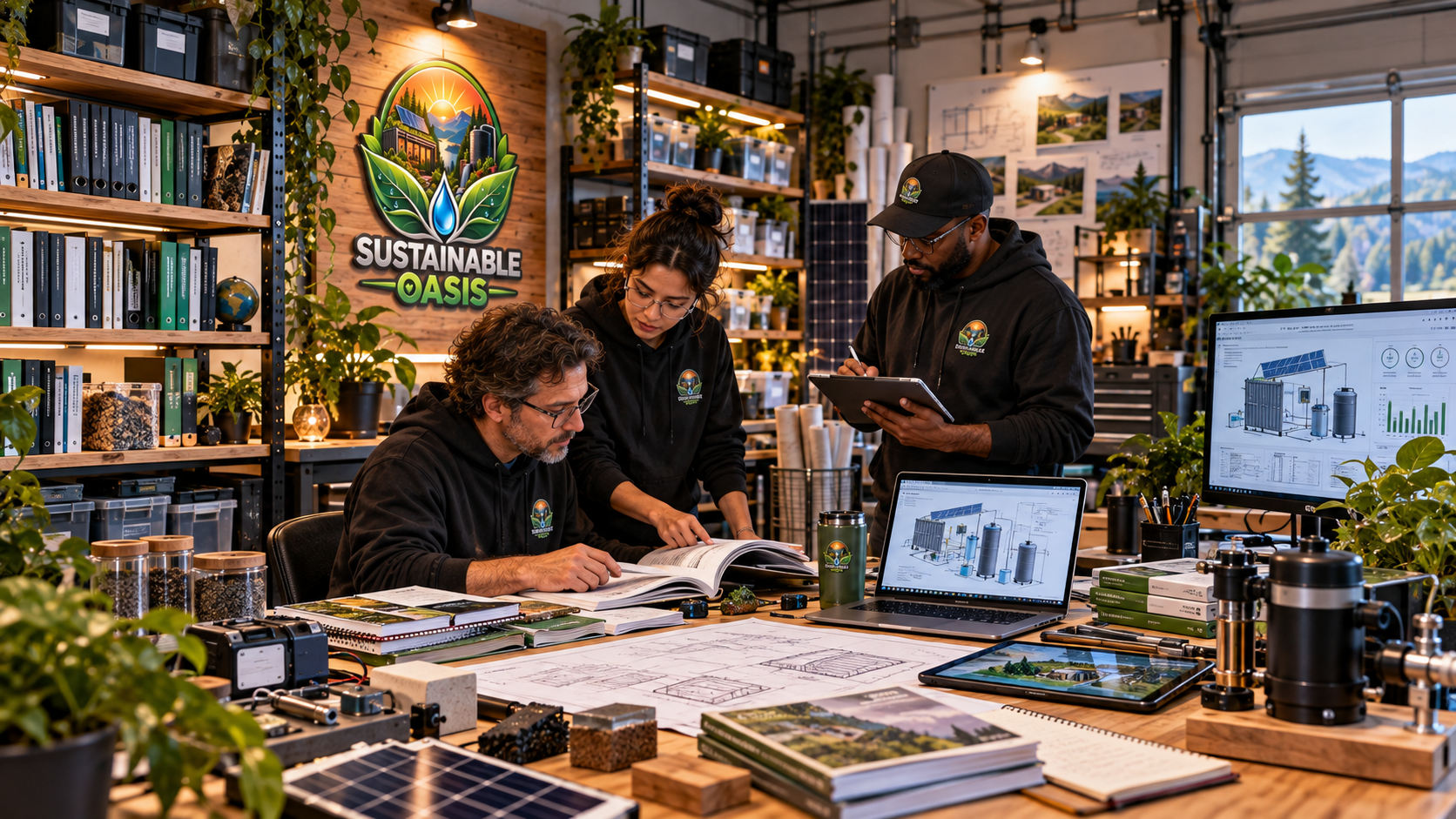
FIELD KNOWLEDGE PIPELINE
FUTURE VIETNAM OASIS RESOURCES
Terrain, terraces, water and infrastructure locations.
FUTUREWell, storage, flow, demand and autonomy.
FUTURECrops, harvest, area and resource use.
FUTUREGeneration, storage, consumption and pumping.
FUTUREStructured measurements from real site conditions.
FUTURELessons that can inform future terrain-driven Oasis sites.
FUTUREVIETNAM OASIS PRINCIPLES
Use elevation where it can reduce mechanical demand.
Treat water availability as essential infrastructure.
Measure harvest against land, water and energy.
Add automation without losing manual control.
Preserve successes, failures and field conditions.
OUR NORTH STAR
Vietnam Oasis gives Sustainable Oasis an opportunity to explore how infrastructure, water, food and natural systems can support one another.
IN THE FUTURE, SUCCESS WILL NOT BE MEASURED BY WHAT WE HAVE, BUT BY WHAT WE PROTECT.
SUSTAINABLE OASIS PROJECTS
Develop controlled experiments before field deployment.
Garage Lab →Develop compact modular infrastructure.
Container Workshop →Test systems against real terrain and field conditions.
Vietnam Oasis →Explore future deployable infrastructure.
Mobile Oasis →Combine field-tested lessons into one integrated architecture.
Complete Oasis →VIETNAM OASIS